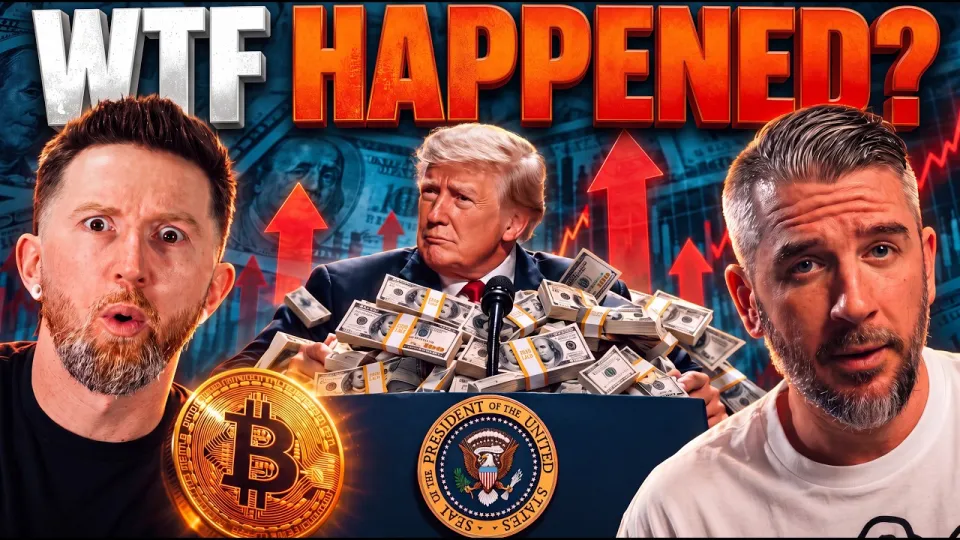
Bitcoin Strategic Reserve, Why America Hasn't Started Buying Yet
Want articles like this for your own video to promote it on YouTube and Google? Order them through the Telegram bot @sat_sit_bot. It writes articles around your video, embeds the video and publishes them on popular niche websites (no ads). Your first 50 articles are free.
· based on the channel Simply Bitcoin
Key takeaways
- The US Strategic Reserve, as framed in the discussion, holds bitcoin already seized by the government rather than coins bought on the open market.
- The panel argues that open-market purchases at scale would move the price and hand an advantage to existing holders before the state accumulates a position.
- Political timing and the optics of spending public money on a volatile asset are presented as the main obstacles to active buying.
- The Simply Bitcoin After Hours format pairs Rustin, Hurley and Opti, whose contrasting styles drive the debate.
- Viewers repeatedly asked for more episodes of the unedited, unfiltered three-person format.
Bitcoin has not been bought for the US Strategic Reserve because, in the framing of the Simply Bitcoin panel, the reserve so far consists of coins the government already holds through seizures rather than coins acquired on the open market. The discussion argues that active buying at scale would move the price against the buyer, reward existing holders first, and carry political costs that no administration wants to absorb early. The result is a reserve that exists on paper and in custody, but not yet in the order book.
What the Strategic Reserve actually contains
The distinction between a stockpile and a purchase programme is the starting point for everything else. A stockpile is what you already own; a purchase programme is a decision to buy more at market prices, and that decision is where the political and economic friction lives.
Under this reading, the reserve is built from bitcoin the US government has confiscated in enforcement actions over the years. Those coins sit in government custody and can be transferred into a formal reserve structure without a single dollar of new spending. That is a legally and politically cheap move, and it explains why the reserve can be announced while the market sees no buying pressure.
- Existing holdings: coins already in government hands, moved rather than bought.
- Open-market buying: requires appropriations, price discovery and public justification.
- The gap between them: the entire reason the reserve exists without a visible bid.
The panel treats this as a deliberate sequencing choice, not an oversight.
Why open-market bitcoin purchases are politically expensive
Buying bitcoin with public money means buying a volatile asset at whatever price the market offers, and the panel stresses how badly that plays in a political cycle. Every dollar spent is a dollar that can be contrasted with roads, defence or debt service.
There is also the optics of timing. If the government buys and the price falls, the loss is on the front page. If the price rises, critics argue the state enriched early holders. The panel describes this as a no-win headline risk that makes officials prefer to do nothing visible.
The market impact argument: who benefits from a state bid
The third pillar of the argument is mechanical: a large sovereign buyer is a price taker, and price takers pay more the more they buy. The discussion frames this as a transfer of value from the state to everyone who already holds bitcoin.
If the Treasury tried to accumulate a meaningful position quickly, the order flow itself would signal intent and push the price up before the position was built. Slow accumulation avoids that but stretches the programme over years and exposes it to every political change in between. The panel treats this dilemma as the real reason for caution, not any lack of conviction about bitcoin itself.
How the panel frames the politics and the timing
The conversation, presented as an unedited three-way format, sets Rustin's confrontational style against Hurley's calmer read, with Opti holding the middle. That contrast is what makes the timing argument legible: one side pushes urgency, the other explains why patience is rational for the people making the decision.
The panel's conclusion is that the reserve is a signal of intent rather than a promise of demand. Announcing that the state will keep the bitcoin it seizes tells the market the asset is being treated as a strategic holding; it does not commit anyone to buy a single coin. Listeners who expected a sovereign bid were reading the announcement as something it was not.
Questions viewers keep raising about the reserve
Audience reaction to the episode clustered around a few recurring doubts, and they are worth addressing directly because they reflect how the announcement was understood outside the panel.
- "If the reserve exists, why is the price not moving?" Because the reserve is composed of coins already held, so no new demand hits the market.
- "Will the government ever buy?" The panel treats buying as possible but conditional on political cover and a method that does not front-run itself.
- "Does this mean the US is pro-bitcoin?" It means the US treats seized bitcoin as worth keeping rather than auctioning off, which is a meaningful but narrower statement.
- "What would change the picture?" A formal appropriation or an explicit purchase mandate, neither of which the discussion identifies as imminent.
What would actually signal sovereign demand
The clearest signal would not be a press release but a budget line. An appropriation dedicated to bitcoin accumulation, a published acquisition schedule, or a custodian mandated to execute purchases would all convert the reserve from a storage decision into a demand decision.
Until then, the panel advises watching custody arrangements and enforcement flows rather than headlines. Coins moving from seized holdings into a reserve structure are a statement about intent; coins moving from an exchange into a government wallet under a purchase mandate would be a statement about demand. The difference between those two flows is the whole story.
Summary
The Simply Bitcoin discussion makes a straightforward case: America has not bought bitcoin for its Strategic Reserve because the reserve was designed around coins the government already owns, and because open-market purchases carry price impact, political risk and headline exposure that officials would rather avoid. The panel argues the announcement signals intent to hold, not intent to buy, and that a real sovereign bid would show up as an appropriation or a published acquisition plan. For a market that expected a state buyer, that gap between signal and demand is the whole story. The breakdown comes from the Simply Bitcoin channel, whose After Hours format puts Rustin, Hurley and Opti in the same conversation.
Source: LEAKED: Here's The REAL Reason America Hasn't Bought Bitcoin For its Strategic Reserve... · Markdown version
Questions & answers
Has the US government actually bought any bitcoin for its Strategic Reserve?
According to the discussion, no open-market purchase programme has been described. The reserve is framed as being built from bitcoin the government already holds through seizures, which is why the announcement did not produce visible buying pressure in the market.
Why would buying bitcoin be a problem for the government?
A large sovereign buyer is a price taker, so the act of buying pushes the price up before the position is complete. On top of that, spending public money on a volatile asset creates political and headline risk, which the panel identifies as the main brake on any purchase programme.
What would prove that real sovereign demand is coming?
A dedicated appropriation, a published acquisition schedule, or a custodian explicitly mandated to execute purchases. Without one of those, coins moving into a reserve structure reflect custody decisions rather than new demand hitting the market.
Does holding seized bitcoin mean the US is officially pro-bitcoin?
It means the government considers seized bitcoin worth keeping instead of auctioning, which is a meaningful shift in treatment. The panel stresses it is narrower than a commitment to accumulate, since it involves no new spending and no purchase mandate.